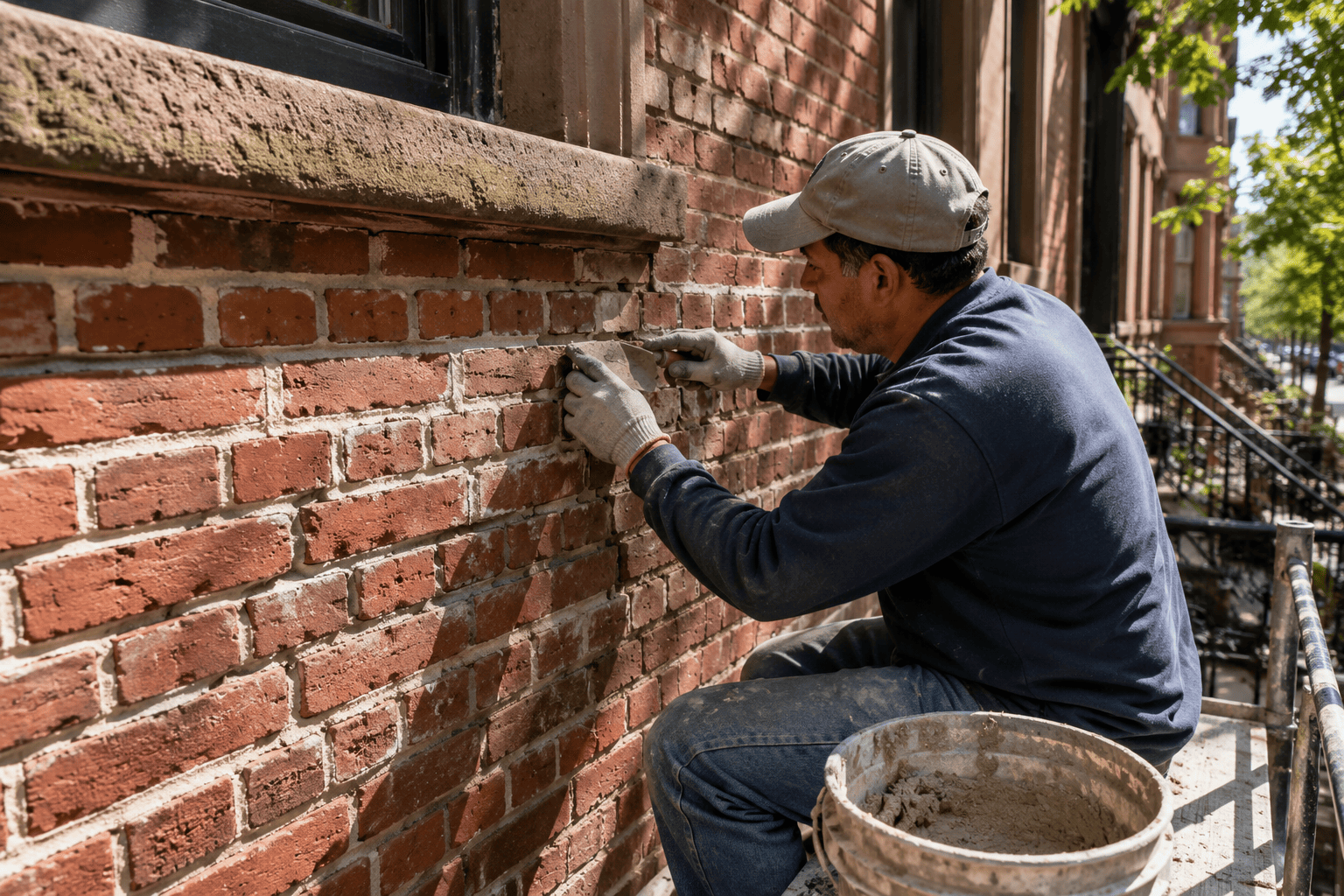
A brick pointing contractor can help protect an older Brooklyn home when mortar starts to crumble, joints open up, or moisture begins to get into the brickwork. In neighborhoods filled with pre-war rowhouses, brownstones, and older two-family homes, the right brick pointing contractor can make the difference between a long-lasting repair and damage that keeps getting worse. This guide explains what homeowners need to know before hiring for pointing work on an older property.
However, not all brick pointing contractors understand the characteristics of older buildings. Contractors do more harm with the wrong approach (wrong mortar, wrong technique, wrong timing) than they do with the right one. That is no small matter in a 100-year-old building.
Here is what Brooklyn homeowners with older homes need to know.
Why Brick Pointing Is Even More Important for Older Homes
Brick pointing (also known as repointing or tuckpointing) involves removing and replacing deteriorated mortar in brick joints with new mortar.
By design, mortar is softer than brick. It absorbs movement, moisture, and stress, which prevents the bricks themselves from cracking. As time passes, usually after 25 to 30 years, that mortar starts to deteriorate, becomes porous, and begins to crumble. When that happens, water gets in.
Older houses need more attention for a simple reason: they have gone through more cycles.
A Brooklyn rowhouse built in 1910 has already gone through more than 100 New York winters, including freeze-thaw cycles, moisture exposure, and temperature changes. Even when contractors have repointed the building periodically throughout its life, some areas almost always show signs of wear.
The Original Construction Matters
The original construction is the other factor.
Builders constructed those buildings with lime-based mortars, which were softer, more flexible, and more breathable than modern Portland cement-based mortars. In most cases, those original mortars are now very old and require experience to match correctly.
The Mortar Problem Most Contractors Get Wrong
This is the single most important thing to understand about brick pointing on older Brooklyn homes.
Modern mortar mainly contains Portland cement. It is strong, hard, and widely available. It is also the wrong choice for most Brooklyn buildings built before 1950.
Why the Wrong Mortar Causes Damage
Builders commonly used soft brick in Brooklyn rowhouses and brownstones before World War II. They intentionally made the original lime mortar weaker than the brick so that if movement occurred, the mortar would crack or compress instead of the brick itself.
If a contractor uses hard Portland cement mortar on soft historic brick, the relationship reverses. The mortar becomes stronger than the brick.
The joints can no longer absorb movement and moisture, so the stress transfers directly into the brick faces. The result is:
- Spalling
- Cracking
- Permanent brick damage
- Costly future repairs
This mistake happens throughout Brooklyn every year.
The damage often goes unnoticed at first, which makes it even worse. By the time the problems become visible, the contractor is usually long gone.
The Correct Mortar for Older Homes
Whenever possible, contractors should use lime-based mortars, whether natural hydraulic lime or a lime-putty mixture, to match the original mortar in:
- Strength
- Color
- Texture
Do not hesitate to ask your contractor what type of mortar they plan to use and why. A specialist with experience in older buildings will answer immediately and confidently.
What Brick Pointing Costs on Older Brooklyn Homes
Older homes often cost more to repoint than newer buildings for several reasons.
Why Older Buildings Cost More:
- Lime-based mortars cost more than standard Portland cement mortar
- Mortar color and texture matching requires additional labor
- Older buildings often contain previous repairs that contractors completed incorrectly
- Contractors often need to remove wrong materials before proper work can begin
- Brooklyn rowhouses commonly require scaffolding
Typical Brick Pointing Costs:
- Small section repair (10 to 25 sq ft): $500 to $1,800
- Repointing a single facade of a typical rowhouse: $6,000 to $13,000
- Repointing an entire building, including rear and sides: $15,000 to $40,000+
- Chimney repairs on an older house: $900 to $3,500
- Parapet repointing: $1,500 to $5,000
Older building work in Brooklyn generally falls on the higher end of the scale and averages $10 to $20 per square foot because of the specialized materials and labor involved. Not every mason is the right brick pointing contractor for older homes with soft historic brick.
Typical Project Timelines:
- Single rowhouse facade: 4 to 7 days
- Larger projects: 2 to 4 weeks
Landmark Districts: What Brooklyn Homeowners Need to Know
Many historic homes in Brooklyn sit within designated landmark districts.
Areas including Brooklyn Heights, Park Slope, Cobble Hill, Carroll Gardens, Fort Greene, and Boerum Hill fall under the Landmarks Preservation Commission (LPC).
Additional Requirements in Landmark Districts
In these areas, contractors must complete repointing work with materials and techniques that preserve the historic character of the building. An experienced brick pointing contractor can spot early mortar failure before it turns into widespread brick damage.
This may include:
- Lime-based mortar requirements
- Mortar color matching
- Historic joint profiles
- LPC approval before work begins
If a contractor fails to follow these guidelines, the owner can face fines and may have to remove the completed work.
Make sure your contractor understands LPC requirements and can handle the approval process when necessary.
Signs Your Older Brooklyn Home Needs Brick Pointing
Look for warning signs from the street and up close whenever possible.
Exterior Warning Signs:
- Mortar that is soft or crumbling
- Mortar that you can scrape out with a key or fingernail
- Empty joints or voids where mortar has completely disappeared
- White staining on brick surfaces (efflorescence)
- Brick faces that are flaking or popping off
- Older gray Portland cement patches applied over softer historic joints
Interior Warning Signs
- Moisture or dampness on interior walls after heavy rainfall
When to Call a Specialist
If you notice any of these conditions on a building that is more than 50 years old, it is time to call a brick pointing specialist.
Older Brooklyn homes require specialized knowledge. This is not work for a general contractor or someone who only performs masonry occasionally. Proper pointing protects the structure, preserves the historic brick, and prevents minor mortar issues from becoming major structural repairs.
Why Gushi Construction for Older Brooklyn Homes
Gushi Construction has handled brick pointing and masonry restoration across Brooklyn since 1993. That is more than 30 years of work on the borough’s pre-war rowhouses, brownstones, and older two-family homes.
The team understands historic mortar matching, works within landmark district requirements, and uses the right materials for the building in front of them, not whatever is fastest or cheapest. They are licensed, insured, and available seven days a week.
Free estimates with no obligation. If your older home needs pointing, get a professional eye on it before the next winter causes more damage.